We build self-improving products.
A product should get better every week, not only when someone finds the time. Flowgrid flags what changed, investigates when you ask and drafts the next improvement. Your team makes the call.
Software has been passive.It waited for someone to notice.
A self-improving product doesn’t wait. Something notices what changed, finds out why and prepares the next change, so your team spends its time deciding instead of digging. Flowgrid takes the steps that are only work, and leaves you the one that is a decision.
- 01Notice something movedSomeone opens a dashboard and spots it, eventually.The watch checks your key numbers on a schedule and flags a real shift on its own.
- 02Find the dataThree tools, five tabs and a spreadsheet.Events, sessions and your code, read in one pass and listed with the answer.
- 03Work out whyA meeting, and the loudest guess wins.The change split by what explains it, with the sessions behind it. A pattern is called a pattern.
- 04Decide what to changeA ticket that waits for next sprint.The fix as a pull request, a test to prove it, a flag to roll it out.
- 05Ship itWhoever has time.YouYou approve, your team merges. This step stays yours.
- 06Check it workedUsually never.The experiment calls a winner, and the watch keeps checking the number.
Conversions
59 a day18%Signups
41212%Bounce rate
61%9 ptsRevenue
$1,840 a day7%Checkout errors
2143x
- Agent watch09:00
Conversions fell 18% this week
59 a day over 27 Oct – 2 Nov, against 72 a day the four weeks before.
Ask the agent why - Waiting for you09:14
Fix the payment step on iOS Safari
A pull request is drafted. It opens once you approve it.
Review - ExperimentYesterday
Shorter signup form won
Called against the control on signups.
- ReportMonday
Weekly report sent to 4 people
Written from this week’s numbers.
Observe. Understand. Decide.Improve. Learn. Again.
Every day it checks your numbers against the weeks before.
Station 1 of 5
Observe
A system that drives your product to improve itself.
It watches your key numbers, works out what moved and why, drafts the next improvement and measures what it did. Lap after lap, you build on what you learned, and your team signs off on what ships.
The improvement loop
One loop. It changes every team.
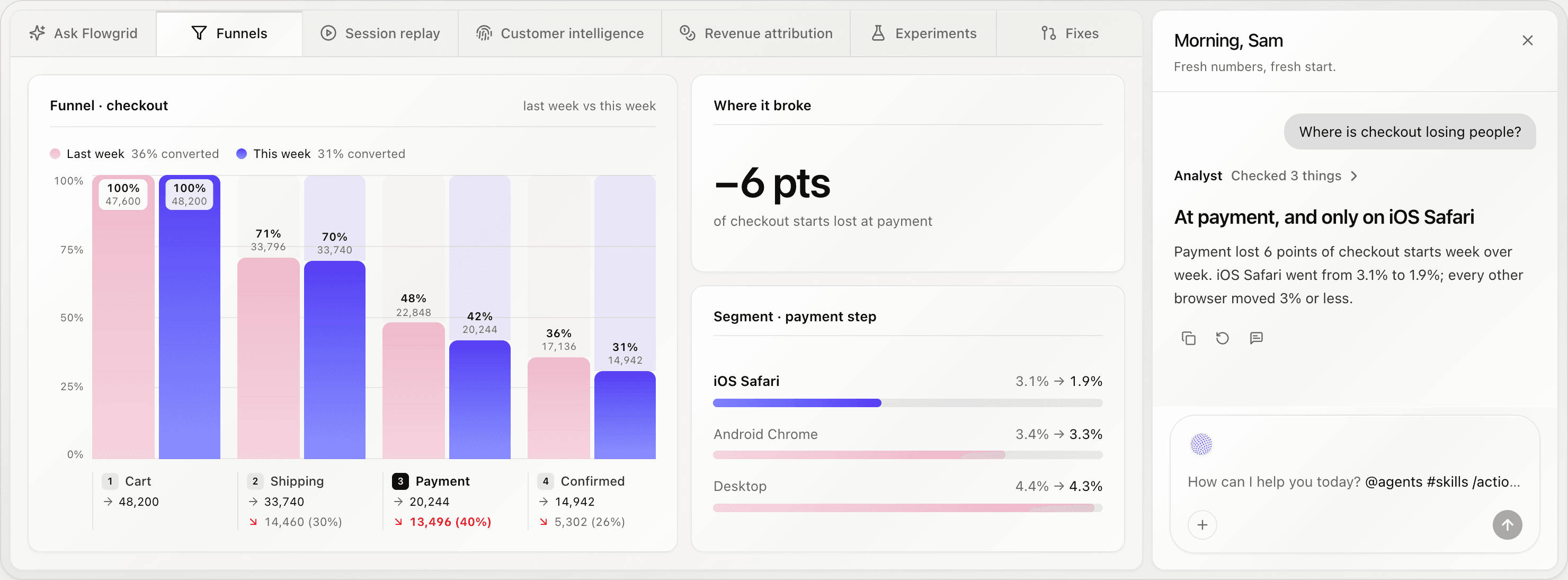
A self-improving product isn’t only a product team’s project. Everyone works from the same events, sessions and customers. The watch flags shifts on a schedule, and investigations run when you ask.
Stop digging for the reason.
When a number moves, you start from the cause and the sessions behind it, not from a blank dashboard.
- NoticesConversions dropped this week
- ExplainsMobile users stall on the second step
- DraftsThe fix, and a test to prove it
- YouYou decideApprove it, change it or drop it
You don’t rebuild anything to start.
Adopting a self-improving product workflow starts with one script and one question. Each step adds to the last.
- 01
Add one script
Events and sessions start arriving, with no tracking plan to write first.
- 02
Ask your first question
Ask why a number moved and get the answer with the evidence behind it.
- 03
Connect what you run
Add your CRM and your repository, so answers reach your customers and your code.
- 04
Let the loop run
After about five weeks of data, the watch starts flagging real shifts on its own.
Which number would you improve first?
Tell us about it and we’ll set up thirty minutes to work through it with you.
- A walk through one investigation, from a changed number to the drafted next step
- What your first loop would look like on your website or product
- What it takes to set up, and what you can leave as it is
Questions, answered.
What is a self-improving product?
A product that keeps getting better because noticing problems, finding the cause and preparing the next change happen continuously, instead of waiting for someone to have time. People still decide what ships.
Does Flowgrid change my product on its own?
No. Flowgrid drafts pull requests, experiments, flags and CRM notes, and each one waits for a person on your team to approve it. It cannot merge code.
How is this different from product analytics?
Analytics tells you what happened and leaves the rest to you. Flowgrid includes the analytics, then carries on: ask why something changed and it explains, shows the sessions behind it and drafts the next step.
Which teams use a self-improving product workflow?
Product, marketing, sales, engineering and leadership all work from the same events, sessions and customer records, so each team gets its own answers without a separate tool.
What do I need to get started?
One script on your website. Connecting your CRM and your repository is optional, and adds customer and code context to what the agents can read.